

Submitting Your Work
What your instructor configured wins. This page describes how Pawtograder behaves in the setup most courses use. Almost every rule below is a per-assignment or per-course setting, and your instructor chose the settings for your course on purpose, as part of how they want the course to run. So if your assignment behaves differently from what you read here, the most likely reason is that your course is set up differently, by design. Your assignment page and your course’s own policies are the authority on what applies to you. Ask your course staff if you are not sure, or if what you see looks wrong rather than merely different.
The Short Version
Your instructor set up a starter repository for you. Clone it, do the work, commit, and push tomain. Every push is a submission, and the autograder runs on it. That is all you have to do — you do not need to write anything special in your commit message.
If you push three commits at once, the last one is the one that gets graded.
Your Assignment Repository
Once an assignment has been released by your instructor, you’ll see it in the Assignments tab. A link to your GitHub repository for the assignment appears in the repository box below the assignment’s due date and description. This repository is private, and only you and the course staff can see it. Your instructor may have provided starter code in that repository. Use this repository to complete the assignment.What Counts as a Submission
On an assignment with an autograder, every push is a submission. The branches that count are the ones listed in the grading workflow in your own repository, at.github/workflows/grade.yml; as that workflow ships, the branch is main. The last commit in the push is the one that gets graded, so if you push three commits at once, only the third is submitted.
On an assignment with no autograder there is no workflow at all. Each push to your default branch up to your deadline is recorded as a submission for the course staff to grade by hand.
Submission Limits
Pawtograder limits how many autograded submissions you can make in a rolling window, and it does this on every assignment. A new assignment starts out at 5 submissions per 24 hours. Your instructor can raise that, lower it, shorten or lengthen the window, or remove the limit entirely. The window is a rolling lookback from right now, not a calendar day: if you used your fifth submission at 3pm yesterday, you get one back at 3pm today. What counts against the limit:- A submission whose autograder run finished with a score above zero counts.
- A submission whose autograder run finished with a score of exactly zero does not count.
- A submission whose autograder run has not finished yet does count, right up until it finishes and turns out to have scored zero.
- A
#NOT-GRADEDsubmission counts, even though it can never be graded. - On a group assignment, the whole group shares one quota.
When the window is an hour or longer, the assignment page also shows a “Submission Limit for this assignment” notice telling you how many submissions you have used and how many remain. On the shortest window your instructor can choose — 10 minutes — that notice does not appear, but the limit is still enforced.
Ungraded Submissions
Most assignments let you keep pushing after your deadline as long as the commit message contains#NOT-GRADED — matched case-insensitively, unlike #submit. That is what the marker is for. The push still runs the autograder, so you still get feedback, but the submission can never become your active submission and so can never be the one that is graded.
Some courses switch this off. If yours has, a #NOT-GRADED push after your due date is rejected with “This assignment does not allow NOT-GRADED submissions. Please contact your instructor if you need an extension.”
If You Pushed and Nothing Happened
- No grading run appeared at all. Open
.github/workflows/grade.ymlin your repository and look at itson:block. Ifpush:is not listed there, grading on your assignment starts only when the head commit of your push — the last one — has#submitin its message, spelled exactly that way in lower case. A marker on an earlier commit in the same push does not count, and neither does#Submitor#SUBMIT. Some instructors set an assignment up this way so that you submit on purpose rather than on every save. - Your push was rejected by GitHub. Force-pushes to your default branch are blocked on most assignments, so a
git push --forceafter a rebase or an amended commit will fail. Make a normal commit and push that instead. - You cannot clone or push the repository at all. That is a GitHub access problem rather than an assignment setting. See GitHub Help, which separates “the repository opens in my browser but I cannot clone it” from “the repository is not there”.
- You are over the submission limit. See Submission Limits.
Viewing Submission Results
You’ll see a list of all the submissions you’ve made for the assignment. The flag icon indicates your active submission, which is the one that will eventually be graded. To make an earlier submission the active one, open any submission’s page, find that submission’s row in the Submission History panel, and press Activate. You can re-pick your active submission as often as you like until the hard deadline passes, extensions and late tokens included. After it passes, only the course staff can change your active submission. The Submission History table has five columns: Submission #, Date, Commit, Auto Grader Score and Total Score.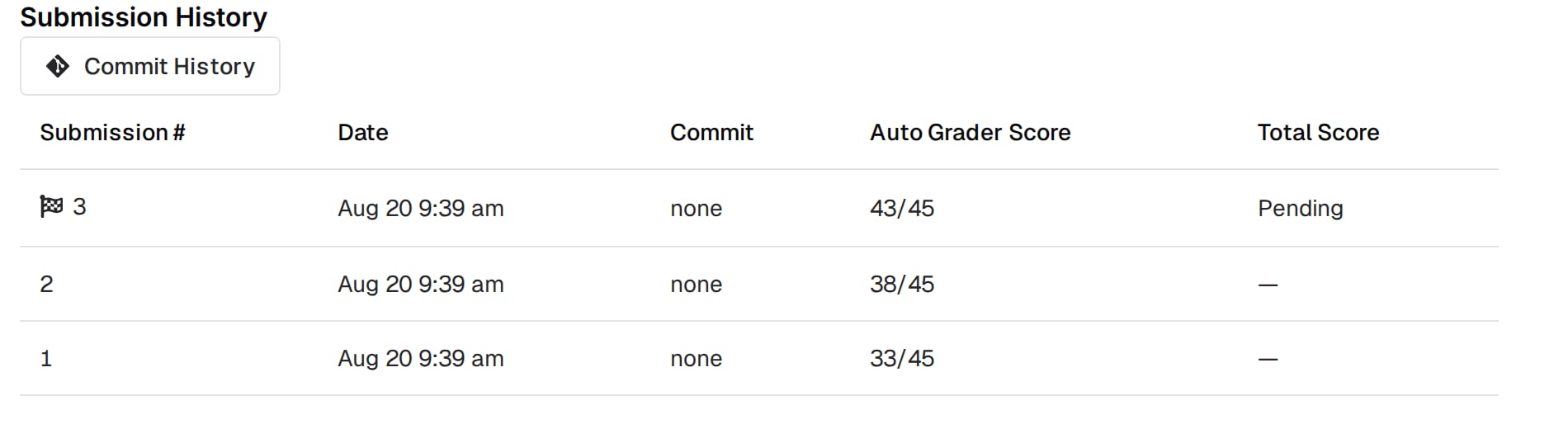
score/max once the run finishes, In Progress while it is still running, Error if the run failed or the push was rejected, and N/A for a submission the autograder never runs on, such as an upload, a pull request, or an entry your instructor made by hand.
Total Score is your overall grade, and it never shows a partial autograder figure. It reads Pending on your active submission until your instructor has completed and released the review, then total/points possible. A #NOT-GRADED submission reads Not for grading, and any other inactive submission reads —.
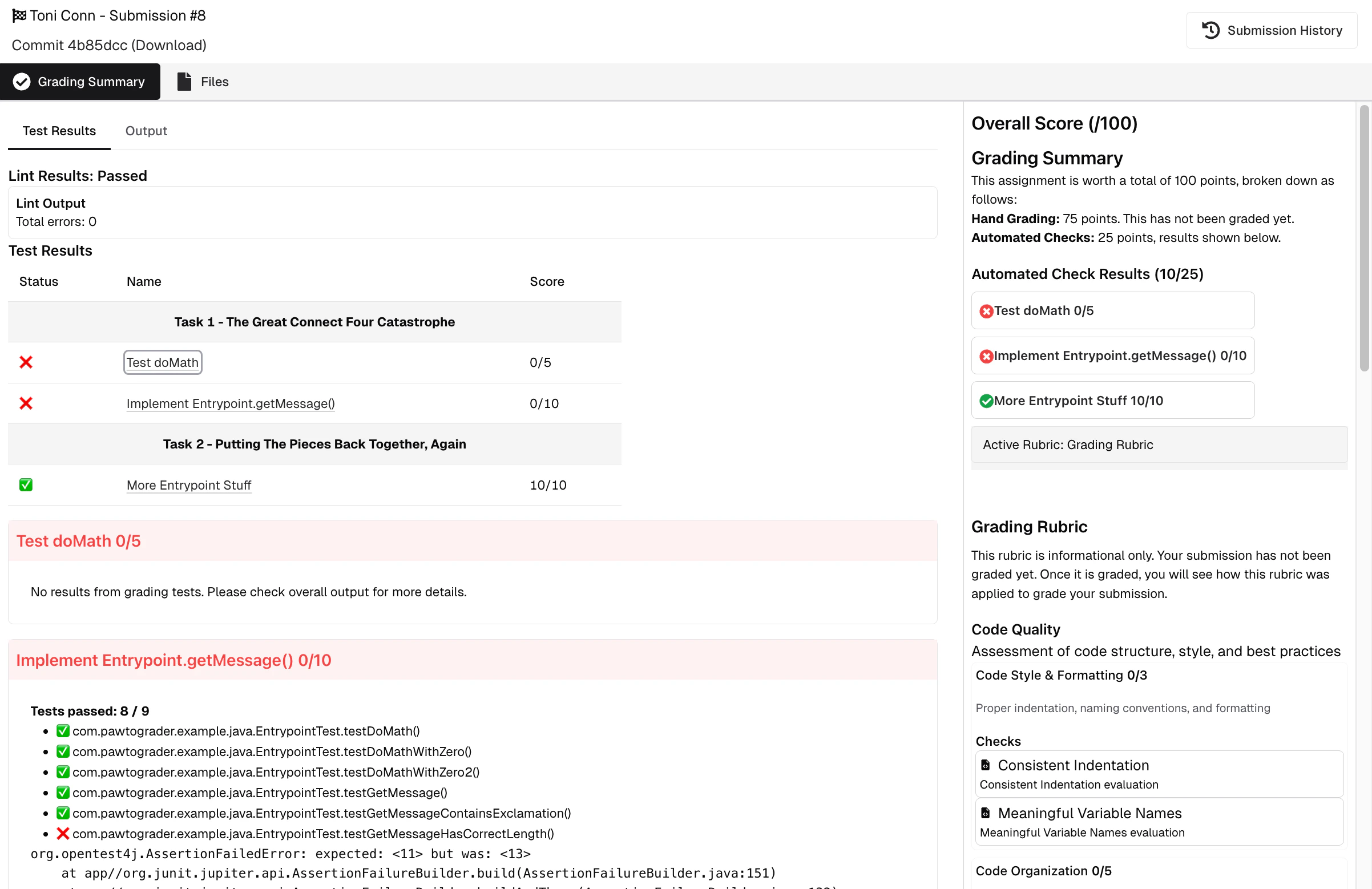
Opening a submission gives you three tabs: Grade, which is a self-contained ledger of how the grade was reached, Autograder Detail, and Files. Pull-request submissions add Checks and Deployments.

Viewing Submission Files
The Files tab shows the files that your instructor configured for the submission. You can view plaintext and markdown files directly in the browser, and download other file types.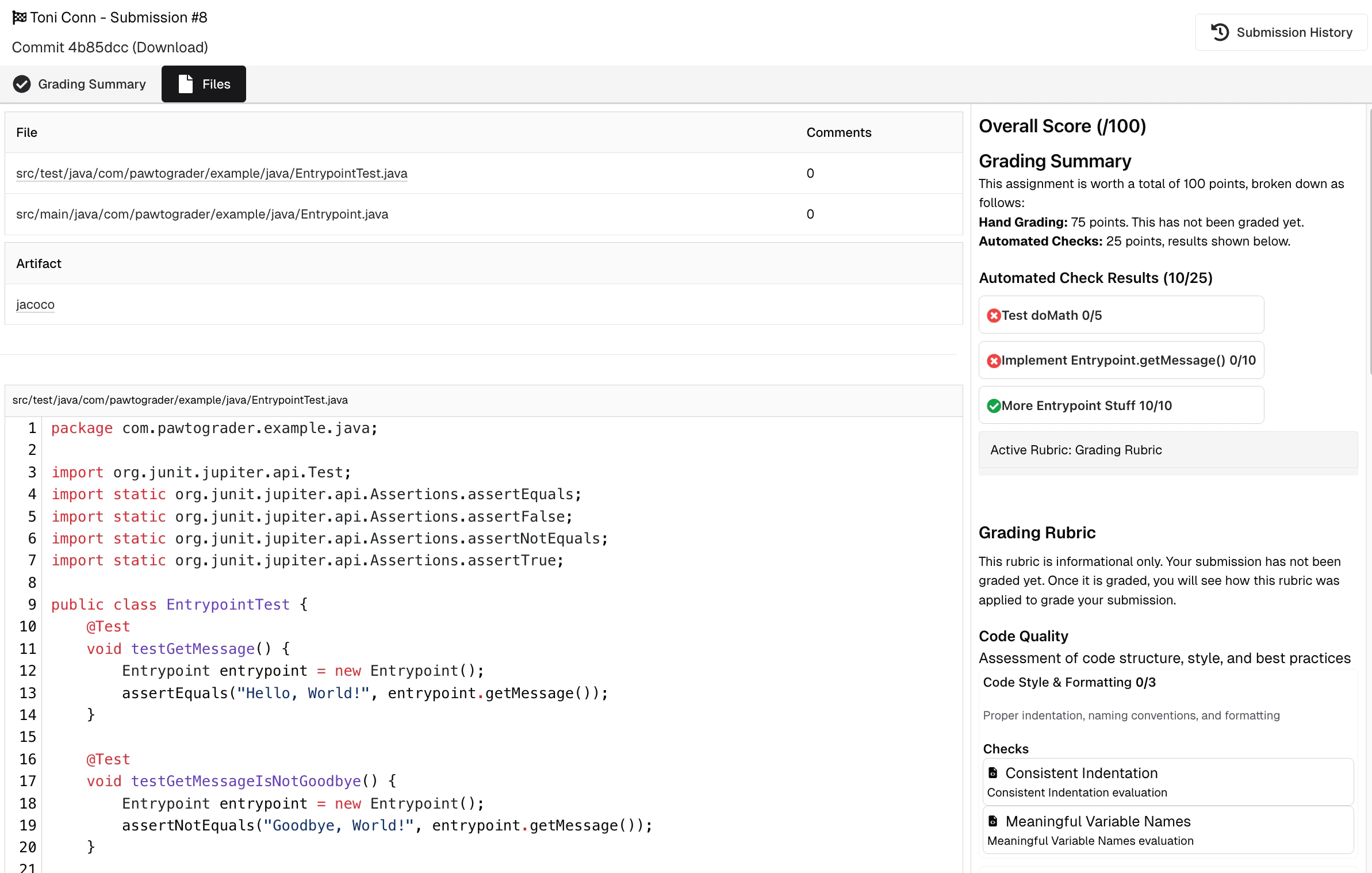
File Previews
Pawtograder provides rich previews for different file types in your submission:- Code files: Syntax-highlighted source code with line numbers and line-by-line commenting (
.java,.py,.js,.cpp, configuration files like.json,.yaml,.xml, plain.txt, etc.) - Markdown files (
.md,.markdown): Rendered with full formatting including Mermaid diagrams, images (supporting relative paths to other submission files), tables, task lists, syntax-highlighted code blocks, and internal links. You can toggle between preview and source view. - Images (
.png,.jpg,.gif, etc.): Displayed inline at full resolution - PDFs: Previewed directly in the browser
- Other binary files: Available for download with file size and type information displayed
Binary files are collected only if they match one of the file patterns your instructor configured, the same as text files. A binary that no pattern matches will not appear in your submission at all. Give binary artifacts a conventional file extension — a binary with an unusual extension or none at all is stored as text, which corrupts it.
Assignment Leaderboard
If your instructor has enabled the leaderboard for an assignment, it appears as a panel in the right-hand sidebar of the assignment page, listing the top ten entries. Assignments without it show no panel at all. See Leaderboards for how the ranking works.Error Pins
Some courses attach a discussion board post to a particular autograder result, so that a student who runs into a problem the staff have already explained is pointed straight at the thread explaining it. Course staff call these error pins. If your course uses them and one of them matches your submission, the thread appears in your autograder results as a link, under the line “Looking for troubleshooting help? Check out these related discussion posts that we have auto-matched to the errors in this submission”. Click it to open the thread. If your course has not set any up, nothing extra appears; there is no empty panel for it. The match is made against the autograder results for the submission you are looking at: the name of a check, the output of a check, the autograder’s output, the lint output, or a score landing inside some range. A staff member chose which of those to attach the thread to, so the post you are shown is one a person picked for that situation rather than a search over the text of your error, and there is nothing you have to do to ask for it. It follows that a link can show up next to a check that passed, and that a submission with no autograder run has none. A thread attached to one check appears beside that check; a thread attached to the run as a whole appears above the list of checks. On the Grade tab, a passing check keeps its detail collapsed, so if a link is attached to one you will need to expand that row to see it. If your build failed outright, matched threads are collected instead under a heading reading Troubleshooting Help, next to the build error.Viewing Artifacts
Some assignments produce artifacts: generated outputs from your code such as reports, visualizations, or analysis results. When your submission has artifacts, they are listed beneath the file list on the Files tab, under an Artifact heading. Click one to open it. Pawtograder can preview four artifact formats:- PNG images: Displayed inline
- Plaintext files: Displayed with proper formatting
- Markdown files: Rendered with formatting
- HTML sites: Interactive preview of a generated website, from a ZIP archive
Assignments That Are Not Submitted by Pushing
A few assignments do not use a repository at all. You can tell which kind you have from the assignment page itself:- An Upload submission control where the repository box would be. What you upload is the submission.
- A No submission required notice. There is nothing to hand in; your instructor grades your work directly — a presentation or an oral exam, for example. Your grade appears on the assignment page once it is released.
- A Choose your submission pull request table. Your submission is a pull request rather than a push, and you pick which one counts. Pushes to this kind of repository are ignored entirely, even with
#submitin the commit message.